Thursday, January 14, 2010
The Puritan's Lasting Legacy . . .
The Puritans have left behind many important legacies. First, their strong belief in education led to the establishments of the colleges Harvard and Yale. These are both schools where lots of people want to go because they're such good schools. For example, Harvard University was founded in Massachusetts in 1636. It is the oldest institution of higher learning in the United States. In addition, the Puritan's requirement of grammar schools in the colonies is prominent to present day. Food is another legacy of the Puritans. Some kinds of good they left were meat, canned food, corn bread, etc. Today in some parts of the USA, people grow different crops in the ground to eat. These foods were eaten at the first Thanksgiving, which the Puritans and the Indians started. Thanksgiving is now a very important national holiday. Lastly, the Puritans created a new religion, the Protestant religion. This branch of Christianity is now practiced throughout the entire world. These are all ways that the Puritans have made a lasting effect on present day lifestyle.


Legacy's of the Puritans and Pilgrims
Puritans passed down many things. For example, Harvard University was founded by the Puritans in 1636. Harvard is the oldest institution of higher learning in the United States. The Puritans also founded Thanksgiving. The Pilgrims first arrived/docked in Plymouth Massachusetts in 1620 on December 26. One year later they founded Thanksgiving. Those are some legacy's passed down from the Pilgrims and the Puritans.
Monday, January 11, 2010


Puritans in Plymouth
The early 17th Century was a time of social upheaval in England. Many new protestant sects were challenging the beliefs of the Church of England. The Glorious Revolution and Cromwell had also created a new set of political beliefs. The true believers in representative government (although mostly under a limited monarchy) were the Whigs although some Whigs were more radical than others. The Whigs held a majority for a time, but eventually Tories rose up to support the old system, and a balanced two party system evolved. Given the times, it is not surprising that many of those who came to America were both religious separatists, and dyed in the wool radical Whigs.
The religious separatists had varying beliefs, with the common thread being that they were opposed to, and persecuted by the Anglican Church. Quakers had a rather strong belief in a brotherhood of believers whose combined will was inspired by the will of God. Despite being born to a wealthy and influential family William Penn became a Quaker in his youth. This religious choice shaped his life. The King rewarded Penn’s father with a huge land grant in America, and Penn saw this as a chance to found a colony in which his religious beliefs could be free. He also set up a legislature that was to make laws for Pennsylvania. The Quakers remained a force in Pennsylvania up until and even after the Revolution.
About the same time, religious separatists known as Puritans, who had been forced out of England to the Netherlands set sail on a ship called the Mayflower with the expressed purpose of founding a biblical “city on a hill” in America. During their voyage they drafted some bylaws for their government known as the Mayflower Compact. Thos compact made the new colony in what was to become Massachusetts governed by a representative assembly. The compact was only in force for about 10 years, but it remains the foundation Massachusetts was built upon. Puritans had strong beliefs that living virtuously according to their interpretation of God’s word here on Earth was the only way to heaven.
Over time Puritanism became somewhat less dogmatic and also less prevalent, but in the early days before Salem and the witch trails the intent was to found a pure Godly colony of believers. Despite their professed beliefs the Puritans were also human, and much of the writing of Nathaniel Hawthorne is a commentary upon religious hypocrisy.
In summary, political and religious beliefs were often the motivation for those who chose to come to America in its earliest days. As these colonies became established, and populations multiplied many of the radical beliefs of early 17th Century England became strongly entrenched in America, and a certain amount of neglect or at least hands off treatment by the Crown and Parliament reinforced these beliefs by precedents. By the late 18th Century the descendants of these radicals would become Revolutionaries and founders of a new nation, and do it without breaking with most of the traditions their societies were founded upon.
Click This Link to learn more: Plymouth, Puritans, Penn, Quakers,: Puritans Founded Plymouth and William Penn Founded Pennslyvania http://colonial-america.suite101.com/article.cfm/plymouth_puritans_penn_quakers#ixzz0cKCX9uQJ
Wednesday, January 6, 2010

"Dissent in Massachusetts Bay
Governor John Winthrop expelled Anne Hutchinson from the Massachusetts Bay Colony in 1638."There was not too much room for religious disagreement in the Massachusetts Bay Colony. Puritans defended their DOGMA with uncommon fury. Their devotion to principle was God's work; to ignore God's work was unfathomable. When free-thinkers speak their minds in such a society, conflict inevitably results."
Such was the case in Massachusetts Bay when Anne Hutchinson and Roger Williams spoke their minds.
"ANNE HUTCHINSON was a deeply religious woman. In her understanding of Biblical law, the ministers of Massachusetts had lost their way. She thought the enforcement of proper behavior from church members conflicted with the doctrine of predestination. She asked simply: "If God has predetermined for me salvation or damnation, how could any behavior of mine change my fate?"
Mary Dyer was the first woman executed for her religious beliefs in Massachusetts Bay Colony."This sort of thinking was seen as extremely dangerous. If the public ignored church authority, surely there would be anarchy. The power of the ministers would decrease. Soon over eighty community members were gathering in her parlor to hear her comments on the weekly sermon. Her leadership position as a woman made her seem all the more dangerous to the Puritan order."
The clergy felt that Anne Hutchinson was a threat to the entire Puritan experiment. They decided to arrest her for HERESY. In her trial she argued intelligently with John Winthrop, but the court found her guilty and banished her from Massachusetts Bay in 1637.


Controversy
Controversy
Today, Puritans are subjected to various interpretations and criticisms.
One common criticism is that Puritans were close-minded and fundamentalists. Many pundits posit a Puritan spirit in the United States' political culture, especially in its historical tendency to oppose things such as alcohol and sexuality. On the contrary, some critics have credited Puritanism as being the very spirit that founded American democracy. This view first appeared in Alexis de Tocqueville's Democracy in America.

Religious Beliefs
Puritan belief was developed by religious teachers like John Wycliffe and John Calvin. The Puritans used the bible for guidelines for their government. They wanted to change the church of England and believed in bible reading, praying, praying and preaching. To follow the religion, you must believe in grace, devotion, prayer, and self-examination. The Puritan's religious belief in education, led to establishments such as colleges like Harvard and Yale and grammar schools in the colonies. The Puritans believed that evil deeds were to be blamed on the devil. Their spiritual beliefs were very strong. They believed more in physical than verbal actions. The Puritans felt that god forgave anyone no matter what they did.
Wednesday, December 16, 2009


The Puritans Journey to the New World
 <-- The Mayflower
The Puritans left England so that they could practice their own religion. They started their journey on September 6th, 1620. Their destination, the New World, represented a whole new beginning. Being so far away from their homeland erased the past corruption. They used the Mayflower to make their journey to the New world with 102 passengers and 30 sailors. The 1st part of journey started out well but by the second half the weather was horrible. They originally they were going to take 2 boats to the new world but the 2nd boat named The Speedwell sprung a leak. This forced everybody to cram onto the Mayflower making it very crowded. As a result there was no places to take bathes or wash clothes, the sleeping area was very crowded and to make matters worse there was no heat so when the wether was bad the puritans got wet and cold. The Mayflower was 90 feet long, weighed 180 tons and it was a double decker boat. The people going to the New World called themselves saints.
They had to worry about how much food and water they ate. On the boat they had salted beef or pork, dried peas,salted fish and hard biscuits. They did not land were they wanted to, they were actully quite far off, but they had no choice, so they after 66 days they spotted providence town (in Cape Cod). A young man named William Button died on the trip; he had left his wife and family behind traveling to the New World. People on the ship were sad when he died, but this wasn't the only person who passed away upon The Mayflower.
Upon reaching the New World, the Puritans did not adapt well and had a "starving time" as Jamestown did. Half the people died that first winter, which amounted to around 200 people. There were around 100 people who returned to England. The people who remained were forced to learn how to survive in their new home. The Puritans were unfriendly to the Natives, unlike the Pilgrims. The Puritans starved and suffered Indian attacks. John Winthrop led the Puritans until his death in 1649 and during the 1st year of landing, Winthrop used his own personal wealth to feed many of his followers.
Friday, December 11, 2009
THE PURITANS!
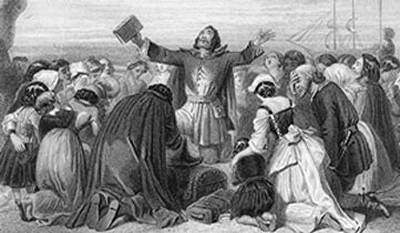 The Puritans believed very deeply in their religion. Their beliefs relied on three different books called The New England Primer, The Bay Psalm Book, and the Bible.
The term Puritan was first used in the late 1500's to identify a party within the Church of England, the national church.
Puritans were members of a religious and social movement of the 1500's and 1600's. The movement began in England and spread to America where it greatly influenced social, political, and religious institutions. Such religious denominations as Congregationalism and Unitarianism developed from Puritan beliefs.
Puritan beliefs developed from the teachings of religious reformers, such as John Wycliffe and John Calvin. Wycliffe was a famous professor of philosophy at Oxford University during the 1300's. Calvin was a leader of the Reformation, the religious movement of the 1500's that gave rise to Protestantism.
The Puritans considered the Bible as the true law of God that provided guidelines for church government. They wished to shape the Church of England to meet their ideals. They called for a less priestly church that emphasized preaching. Puritans believed that all Christian churches should be organized through councils called presbyteries or church courts rather than under bishops, as in the Church of England. Some Puritans believed that each congregation was a complete church in itself and should have total control of its own affairs.
The Puritans emphasized Bible reading, prayer, and preaching in worship services. They simplified the ritual of the sacraments. They also wanted more personal and fewer prescribed prayers. The Puritans stressed grace, devotion, prayer, and self-examination to achieve religious virtue.
The term Puritan was first used in the late 1500's to identify a party within the Church of England, the national church. The party sought to make further changes in the church than had been brought about by Protestant reforms during the reigns of King Henry VIII, King Edward VI, and Queen Elizabeth I. Defenders of these reforms called the party members Puritans because of their proposals to "purify" the church.
As early as the 1520's, English Protestant leaders had demanded reforms along the lines that were later called Puritan. In the 1520's and 1530's, William Tyndale published pamphlets and English translations of the Old Testament and New Testament designed to encourage such reforms. Hugh Latimer, who became an important Protestant bishop, also had raised such protests to purify the church.
Many English Christians agreed with the demands of Tyndale and Latimer that the church and the government be operated according to the Bible. These Christians believed that the Bible governed all human affairs. John Wycliffe had taught this doctrine at Oxford in the 1300's. Under King Edward VI and Queen Elizabeth I, these teachings received support from English clergymen who followed Calvin's doctrine that the New Testament described how the church should be run.
During the 1600's, the Puritans increasingly opposed the political and religious policies of the Stuart rulers, King James I and his son, King Charles I. In 1604, James I called the Hampton Court Conference to settle disagreements within the Church of England. However, James refused to bring about the reforms the Puritans sought, except for a new translation of the Bible, now called the King James Version.
The Puritans gained in strength in Parliament, and repeatedly introduced legislation against the Crown's policies. In 1642, civil war broke out between the Crown forces, called Royalists or Cavaliers, and the Puritans, called Roundheads. They received this name because they cut their hair short. This English Civil War is also called the Puritan Revolution.
The Puritans, led by Oliver Cromwell, won a series of victories and took control of the government in 1649. The Puritans closed theaters and passed other unpopular measures. Their political power ended after Cromwell died in 1658. In 1660, the Stuart dynasty returned to the throne.
Political aspects of the Puritan movement lived on in the policies of the Whig Party in England. Puritan religious ideals were revived in the rise of the Methodist Church in the 1700's.
During the 1600's, some Puritan groups believed that reform of the Church of England was impossible and departed to settle in North America. They founded settlements in Virginia and along the New England coast, especially in Massachusetts Bay Colony and Connecticut.
The Puritans shaped religion, social life, and government in North America to their ideals. Their strong belief in education led them to establish Harvard and Yale as colleges and to require a system of grammar schools in the colonies. The Puritans organized their government according to the teachings that they found in the Bible and on the basis of their English experience.
Late in the 1500's, some Puritans separated from the Church of England and set up their own congregations. Such groups were called Separatists. A group of English Separatists first went to Holland and then founded Plymouth Colony in what is now Massachusetts in 1620. This group of Puritans is better known as Pilgrims. Some Separatists moved to Rhode Island and became Baptists. Others joined the Massachusetts Bay Puritans and became Congregationalists. Thus, while the Puritan movement in England died down, it influenced Protestant denominations in England and America.
Puritan influence also shaped political and social institutions in England and the American Colonies. In England, the Puritan Revolution led to a greater emphasis on limited or constitutional monarchy, in which a constitution, legislature, or both limit the power of a ruler. The Puritans' belief in government by contract from the governed influenced the development of American democratic principles.
Over time, the term puritan has broadened to mean a strictness in morals or religious matters. The term is commonly applied to cultural traits found in the literature of and social attitudes shared by, the New England Colonies. Such traits include an emphasis on education and the glorification of hard work.
The word puritan has also been used to describe reforming attitudes and activities that were not part of the culture of the Puritans. For example, prohibition, the forbidding of the sale or manufacture of alcoholic beverages, and temperance, the avoidance of alcohol, are often called puritan movements. However, the Puritans did not disapprove of the use of alcohol. The term puritan has also come to describe moral attitudes and values that characterize modern movements for rapid social change that require discipline and hard work.
Many social scientists have studied the role of the Puritans in the development of modern social patterns. The German sociologist Max Weber associated the Puritan belief in hard work with the rise of the free enterprise system. Others emphasize the connection between the behaviors and beliefs of the Puritans and those of modern revolutionaries.
Contributor: John F. Wilson, Ph.D., Collord Prof. of Religion, Princeton Univ.
Additional resources
Adair, John E. Founding Fathers: The Puritans in England and America. Dent, 1982.
Foster, Stephen. The Long Argument: English Puritanism and the Shaping of New England Culture, 1570-1700. Univ. of North Carolina Pr., 1991.
Heimert, Alan, and Delbanco, Andrew, eds. The Puritans in America: A Narrative Anthology. Harvard, 1985.
Stephenson, George M. The Puritan Heritage. 1952. Reprint. Greenwood, 1978.
SOURCE: IBM 1999 WORLD BOOK
****
Subscribe to:
Posts (Atom)